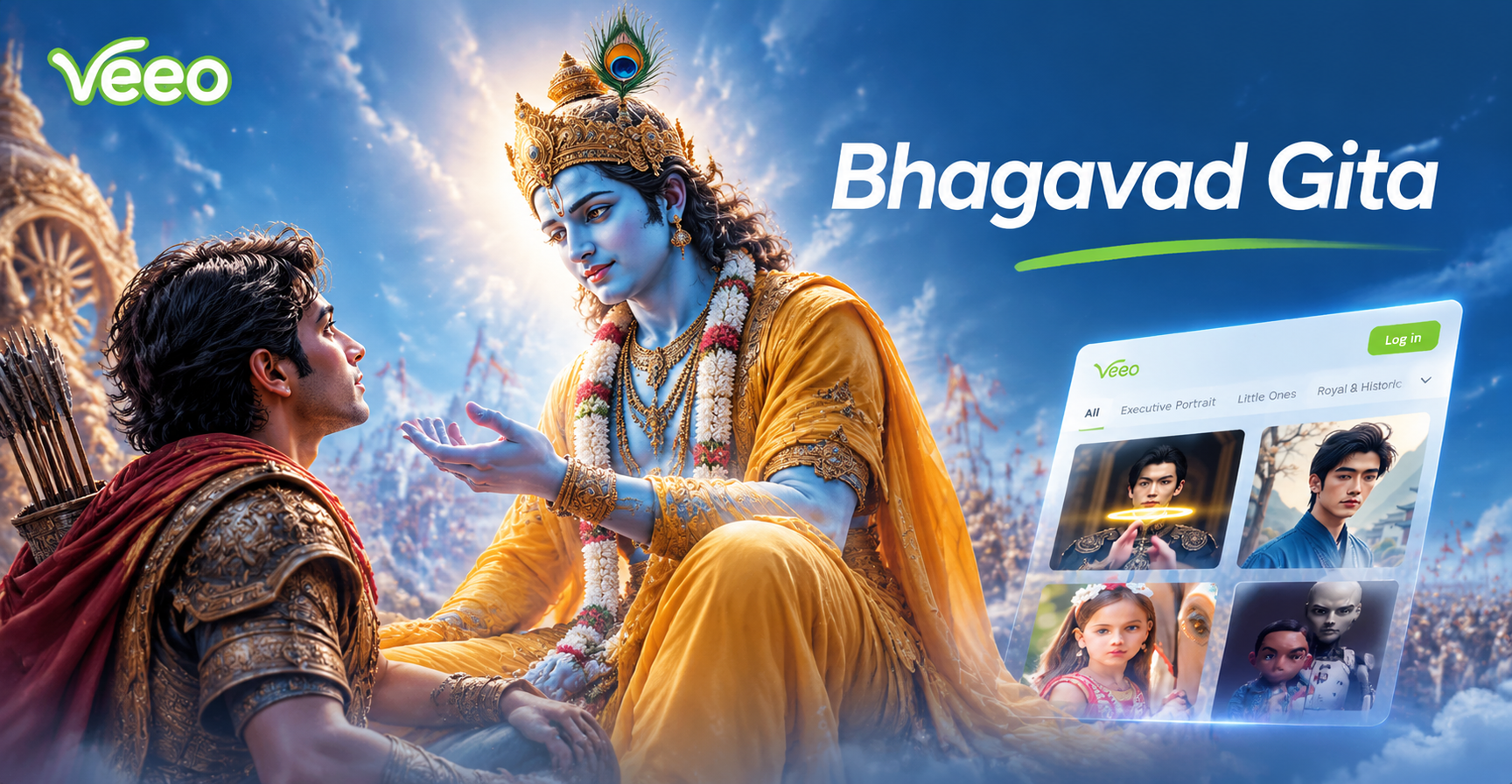
Bhagavad Gita AI image prompts allow you to visualize the sacred dialogue between Krishna and Arjuna, the vast Kurukshetra battlefield, and the cosmic revelation of Vishvarupa. This guide gives you specific, ready to use prompts for creating respectful spiritual art with AI image tools like veeo. Whether you want traditional miniature paintings, cinematic scenes, or symbolic meditative visuals, you can copy these prompts and refine them in the app.
Why Use Bhagavad Gita AI Image Prompts
The Bhagavad Gita is filled with powerful visual imagery: Arjuna's moral struggle, Krishna's calm teaching, the shining chariot, and the overwhelming universal form. A well written prompt gives the AI model enough detail to capture the setting, emotion, and cultural texture. Generic prompts like Krishna talking to Arjuna often produce shallow or inaccurate images. The prompts below include clothing, weapons, light, color, and style details so you can get meaningful results faster.
Quick Prompt Formula
Use this structure for any Bhagavad Gita scene: subject and relationship, setting, emotion or action, clothing and symbolic details, art style, lighting and color, final mood. For example: A serene oil painting of Krishna holding the reins of a golden chariot, Arjuna seated behind him, at dawn on the Kurukshetra battlefield, warm golden light, blue skinned Krishna with a gentle smile, wearing a yellow dhoti and peacock feather crown, cinematic composition, spiritual atmosphere. Keep the details in a natural sentence so the AI can follow the flow.
30 Bhagavad Gita AI Image Prompts
Krishna as the Divine Charioteer
- A detailed oil painting of Krishna holding the reins of a golden chariot, Arjuna seated behind him, at dawn on the Kurukshetra battlefield, warm golden light, blue skinned Krishna with a gentle smile, yellow dhoti and peacock feather crown, cinematic composition, spiritual atmosphere.
- A traditional Indian miniature painting of Krishna as Arjuna's charioteer, two white horses, ornate golden details, flat perspective, rich red and gold colors, lotus motif border, divine calm.
- A close up digital portrait of Krishna speaking the Bhagavad Gita, hand raised in a teaching gesture, soft bokeh of the battlefield behind, teal and gold color palette, glowing skin, peaceful and wise expression.
- A cinematic film still of Krishna and Arjuna on a bronze chariot with five white horses, storm clouds gathering, dramatic lighting, dust rising from the earth, hyperrealistic, epic scale.
- A watercolor illustration of Krishna driving the chariot through misty morning light, soft pastel colors, gentle brush strokes, ethereal and devotional mood.
Arjuna's Inner Conflict
- A moody renaissance painting of Arjuna kneeling in the chariot, his bow fallen beside him, face filled with sorrow, Krishna watching with compassion, dramatic chiaroscuro lighting, dark background, emotional tension.
- A detailed digital portrait of Arjuna in armor with tears in his eyes, looking toward distant armies, sunset light, deep shadows, emotional vulnerability, photorealistic.
- A symbolic art piece showing Arjuna's mind as a split image, one side battlefield chaos, the other side peaceful meditation, Krishna standing between both, surreal composition, soft spiritual light.
- A black and white charcoal sketch of Arjuna and Krishna on the chariot, strong contrast, expressive lines, focus on Arjuna's anguished face, minimalist background.
- A stained glass style image of Arjuna surrendering to Krishna, bright jewel tones, radiating light, sense of inner transformation.
Kurukshetra Battlefield
- A wide panoramic digital painting of the Kurukshetra battlefield at sunrise, two vast armies facing each other, conch shells and war horns, dust and banners, epic and solemn atmosphere, golden haze.
- An aerial view of ancient Kurukshetra with thousands of warriors, elephants, horses and chariots arranged in formation, early morning fog, realistic historical fantasy art.
- A dark dramatic oil painting of the battlefield with storm clouds and lightning, Krishna's chariot at the center glowing softly, armies silhouetted in the distance, spiritual dominance.
- A cinematic wide shot of the two armies before battle, dust swirling, flags of different kingdoms, conch shell raised, tense calm, hyper detailed.
- A traditional Pahari painting of the Kurukshetra war, flat stylized figures, decorative trees and rivers, vibrant colors, narrative border panels.
Vishvarupa The Cosmic Form
- A breathtaking cosmic vision of Krishna's universal form, countless faces, arms and eyes radiating from a central divine figure, galaxies and stars woven into the body, Arjuna kneeling in awe, vibrant electric colors, spiritual and overwhelming, digital art.
- A surreal digital painting of the cosmic form expanding above the battlefield, multiple arms holding divine weapons, sun and moon as eyes, fire and ocean elements, epic scale, glowing energy.
- A traditional Thanjavur painting of Vishvarupa, golden body with many heads and arms, ornate jewelry, red background, devotional South Indian art style, symmetrical composition.
- A glowing ethereal representation of Krishna's universal form as a giant silhouette of light containing all creation, animals, rivers, mountains and stars, Arjuna looking up in wonder, cosmic dust, spiritual awe.
- A dark fantasy illustration of the cosmic form with a hundred heads and infinite arms, each hand holding a symbolic object, swirling galaxies, deep blue and purple palette, dramatic and powerful.
Visual Metaphors for Gita Teachings
- A serene digital artwork of a lotus flower floating on calm water, a single drop of water falling but not disturbing the surface, symbolizing detachment, soft blue and gold colors, meditative mood.
- A symbolic image of a person meditating under a large banyan tree, roots and branches representing the mind and senses, radiating light, peaceful nature scene, spiritual art.
- A surreal painting of a warrior standing on a battlefield while his shadow meditates, representing action without attachment, warm sunset light, thought provoking.
- An artistic representation of the soul as a small radiant lamp inside a glass body, passing through different seasons and landscapes, symbolizing the eternal self, soft glowing colors.
- A minimal digital art of balanced scales, one side holding desires and the other holding duty, a gentle hand guiding the balance, clean composition, symbolic and peaceful.
Traditional and Cinematic Style Add Ons
- Use the phrase Rajasthani miniature painting style with flat perspective, decorative borders and jewel tones for a classical Indian look.
- Use Ajanta cave fresco style with earthy colors, flowing lines and ancient Hindu art influence.
- Use gilded iconography with gold leaf, halo effects and ornate details for a devotional feel.
- Use cinematic film still with dramatic lighting, dust particles and shallow depth of field for an epic mood.
- Use soft watercolor illustration with gentle washes and pastel colors for a meditative and calming feel.
How to Adapt and Improve These Prompts
If an image feels too generic, add one or two culturally specific details. For Krishna, mention the peacock feather crown, yellow silk dhoti, Vaijayanti garland, conch shell or Sudarshana chakra. For the battlefield, mention Kurukshetra plains, chariots with white horses, conch shells and war drums. For Arjuna, mention his bow Gandiva, quiver of arrows and the anguish on his face. Small additions help the AI understand the exact scene and avoid generic Western or fantasy imagery.
Change the art style word at the end of any prompt to shift the mood. For example, replace oil painting with traditional Indian miniature, cinematic film still or soft watercolor. You can also adjust the color palette from warm gold to cool dawn blue, or from rich reds to muted earth tones. If the image looks too modern, add ancient Indian epic setting, traditional attire, no modern objects. If it looks too crowded or chaotic, add simple composition, centered subject, clean background.
Common Weak Results and How to Fix Them
- Krishna looks like a generic blue character. Fix by adding traditional Vaishnava iconography, peacock feather crown, yellow silk dhoti, peaceful and divine expression.
- The battlefield looks like a fantasy war. Fix by adding ancient Kurukshetra plain, two Indian armies with bows, swords, elephants and chariots, no dragons or castles.
- The cosmic form has a confusing jumble of limbs. Fix by adding symmetrical mandala composition, multiple faces arranged in a circular pattern, divine Vishvarupa with many arms holding symbolic objects.
- The image feels disrespectful or casual. Fix by adding devotional tone, sacred art, serene expression, respectful representation. Avoid modern casual clothes and playful poses.
- Faces look too Western. Fix by adding Indian facial features, traditional Indian art style, South Asian features.
Using veeo for Bhagavad Gita Images
The veeo app is a simple mobile tool for turning these prompts into images. Download it from Google Play, open the text to image feature, paste a prompt and choose a style filter such as realistic photography, oil painting, watercolor or traditional art. You do not need complex prompt engineering. The app handles the generation and gives you HD results in seconds. You can also upload a reference image to guide the composition if you want more control over the scene.
A Note on Cultural Respect
Bhagavad Gita imagery belongs to a living spiritual tradition. Use these prompts to create art that honors the scripture rather than turning it into casual entertainment. Avoid mixing sacred figures with inappropriate modern settings, violent humor or commercial stereotypes. When in doubt, choose calm, devotional and beautiful visual language. This approach leads to better AI results and shows respect for the tradition.
Conclusion
Start with one prompt from the list above, paste it into veeo and generate a first image. Then adjust the style, color and details based on what you see. The more specific your prompt, the more meaningful the result. Use these Bhagavad Gita AI image prompts to create sacred art for personal study, storytelling, social media or temple projects, always with care and respect.